




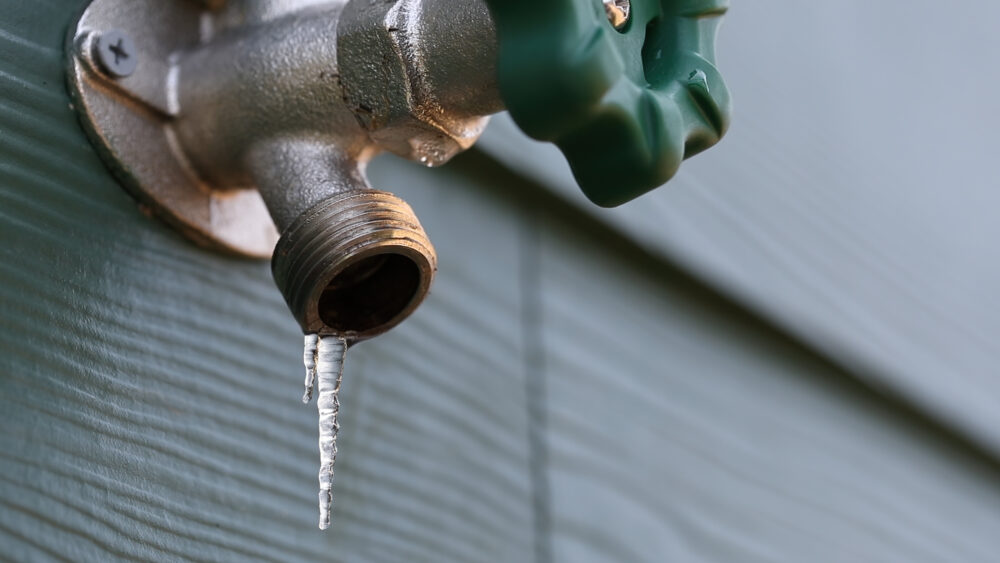
Winter always brings with it a variety of different challenges. One of the biggest things you sometimes have to worry about when the temperature really starts to drop is that it can lead to plumbing pipes freezing. The main risk if any of your pipes freeze is that as the water freezes and turns into ice, it can expand to the point where it causes the pipe to split or rupture and results in a major flood that can cause extensive water damage. Luckily, taking all of the following simple steps is usually all it takes to greatly reduce the chances of any of your pipes freezing.
Disconnect All Hoses and Winterize Your Hose Bibs
One thing you need to make sure to do whenever the first freeze is predicted is to disconnect any hoses you’ve still been using. Even if you take the appropriate precautions to winterize a hose bib, there’s an extremely high chance it will still freeze if a hose is connected to it. That’s because it’s much more difficult to fully drain the water out of the bib when a hose is connected, and the bib can easily end up freezing if even a tiny amount of water remains inside it over the winter.
The process for winterizing a hose bib only takes a few minutes and is something you can easily do yourself in most situations. The first thing you need to do is go into the basement or crawl space and locate the water lines that supply your hose bibs. You should see a valve on the water line right where it connects to the stem of the hose bib that sticks through the wall, and all you need to do is close each of the valves to shut off the water to each bib. The valve will typically either be a ball valve with a straight handle or a gate valve with a disc or wheel. To close a ball valve, you just need to turn the handle 90 degrees so that it is perpendicular to the water line.
With most gate valves, you need to turn the wheel clockwise as far as it will go to shut the water off. Some gate valves instead close by turning the wheel counterclockwise, but the wheel normally has markings that show which direction to turn the wheel to open and close the valve.
You may sometimes encounter a situation with either type of valve where the handle or wheel is stuck and prevents you from closing it. If the valve doesn’t close easily, it’s best to enlist the help of a plumber to either close the valve or replace it if it’s completely stuck. That’s because you could end up breaking the valve or the water line if you try to apply too much pressure.
Once you’ve closed each of the valves, all that’s left is to go outside and open the hose bibs to let them fully drain. Although it normally only takes a few seconds for a bib to drain, it’s a good idea to leave it open for a couple of minutes just to ensure that all of the water drains out. After this time, you then want to make sure to fully close the valve on the bib to prevent cold air from getting inside and reaching the water line.
Upgrade to Frost-Free Hose Bibs
Frost-free hose bibs are specifically designed to reduce the chances of the water line that connects to the bib inside the house from freezing. Standard hose bibs can still easily end up freezing since they only stick a couple of inches inside before connecting to the water line. That means you have water right near the exterior wall where the air can potentially get cold enough that the pipe freezes. The stem on a frost-free bib sticks much further inside before connecting to the water line, which keeps the water far enough away from the wall that it’s much less likely to freeze.
Frost-free bibs will typically have a marking that says either frost-free or frost-proof. You can also tell a frost-free bib from a regular one as it will usually have a plastic or metal anti-siphon cap on top, which you won’t find on a regular bib. If you have any regular bibs, it’s well worth replacing them before winter arrives so that you can lessen the chances of the water line inside your house freezing.
Insulate Your Water Lines
Another key to preventing your indoor plumbing from freezing is to insulate the water lines in any areas of your home that get colder and put the pipes at greater risk of freezing. This especially means any pipes in your attic or crawl space since either area can often end up being around the same temperature as outside during the winter. You may also want to insulate any exposed pipes that run along the concrete foundation walls in a basement since they could also potentially freeze during an extreme cold snap.
If your pipes are already insulated, you should inspect them before a deep freeze since foam pipe insulation can deteriorate over time and sometimes doesn’t last for more than 10 years. What to look for is any sections of insulation that are cracked or have started falling apart as well as any gaps between pieces of insulation where you can see the pipe exposed. You also want to make sure that the insulation is securely attached to the pipe so that no air can get through. If you notice any of these issues, you should make sure to replace the insulation or hire a professional to do it.
Leave a Trickle of Water Running
Even if you take all of the above precautions, there’s still a somewhat high chance that one of your water lines can freeze during one of the rare situations where the Dayton area experiences below-zero temperatures. In this type of situation, the pipes you need to worry most about are those that are located within an exterior wall. The best way to avoid these pipes from freezing is to leave the faucet or shower that these pipes supply running. You only need to open the fixture enough so that there’s a small trickle constantly running and water is continually flowing through the pipes. As long as the water is moving and not just standing still in the pipe, it’s far less likely to end up freezing.
Open Cabinet Doors Underneath Sinks
One other thing you may want to consider doing whenever it’s extremely cold outside is leaving the cabinet doors underneath your kitchen and bathroom sinks open. This is especially helpful if the sink is located along an exterior wall since cold air can end up penetrating through the insulation in the wall and making the area underneath the sink freezing cold. As long as the doors are open, warmer air can get inside and help ensure the pipes don’t get cold enough to freeze.
If you’re concerned about the possibility of your pipes freezing this winter, you can trust the team at [company_name] for help. We’ve been serving the Dayton area since 1949, and we can expertly handle any installation, maintenance and pipe repair needs. If you need to replace your hose bibs, insulate your pipes or require any other plumbing installation, heating or air conditioning service, contact us today.